


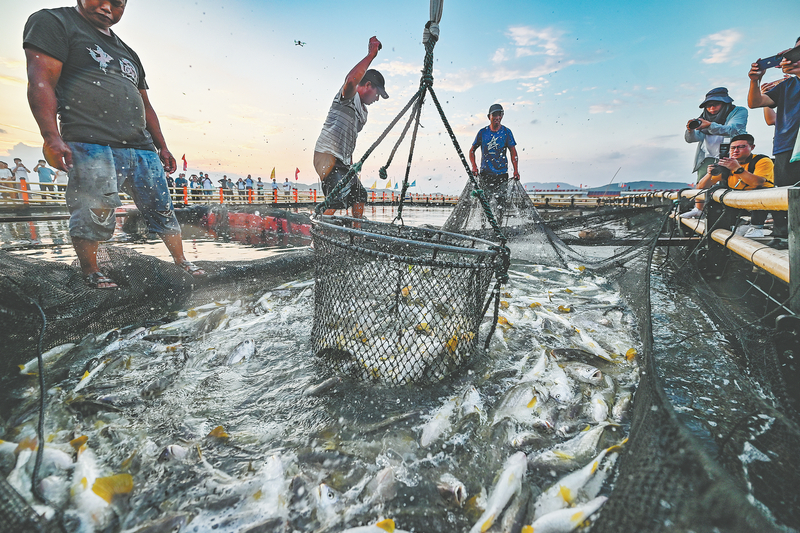
Local fishermen harvest large yellow croaker at sea in Ningde, Fujian province. CHINA DAILY
The city's most popular fish is moving from traditional braised and steamed dishes into frozen fillets and ready-to-eat foods for kitchens at home and abroad, Yang Feiyue reports in Ningde, Fujian.
One fish can now fill a table in Ningde. At recent food events in the coastal city of East China's Fujian province, chefs prepared large yellow croaker in more than 100 ways, ranging from familiar steamed and braised dishes to boneless fillets, ready-to-eat foods and more elaborate creations.
The fish may arrive whole, with its golden skin on. Or it may come cleaned, sliced and packed, ready to go straight into a pan.
The variety is a long way from how locals have traditionally enjoyed it.
Large yellow croaker has long been a familiar fish on the tables of Fujian and neighboring coastal areas, where steaming and braising are among the simplest ways of cooking it.
Ningde, in northeastern Fujian, is now trying to take that familiar fish farther.
The city produced 222,400 metric tons of large yellow croaker in 2025, about 80 percent of China's farmed output. The fish supports an industry covering breeding, aquaculture, processing and distribution, with its products reaching overseas markets as well.
Large yellow croaker once lived in abundance in the waters around Ningde. Guanjingyang, an inner area of Sandu Bay, was an important spawning ground for the species. Decades of intensive fishing, however, severely reduced wild stocks. By the 1980s, the fish had become increasingly scarce.
Researchers then began working on artificial breeding, trying to raise brood stock, induce spawning and improve the survival of young fish.
Around 1990, Ningde achieved large-scale artificial breeding, laying the foundation for the expansion of farmed large yellow croaker.
For Song Xiangguo, who has spent more than 30 years raising large yellow croaker in Ningde, the way to understand the fish is by eating it.
"The flesh is delicate but firm, breaking apart into pieces resembling cloves of garlic when cooked," says Song, manager of Guanjingyang Yellow Croaker Breeding.
Song says some farmed fish can become so close in appearance and texture to wild fish that an ordinary consumer may not be able to tell the difference.
The key to raising a better fish starts with the water around it, Song says.
His company has worked to improve water circulation around its cages, widening waterways and allowing stronger currents to pass through the farming area.
The changes have affected the fish, he says.
"With better water flow, the fish have a better physical shape, their color is better, and the flesh is firmer," Song says.
He says the survival rate has increased by about 10 percent, while selling prices are roughly 5 to 10 percent higher than in previous years.
Food safety is another part of the work.
The farm carries out its own monthly testing and tests fish before they are sold. Technical staff members also visit the farming area regularly to provide advice on disease prevention and treatment.
Song says the farm tries to minimize the use of medication. During periods of high temperatures, if the fish are not feeding well, farmers sometimes stop feeding them for several days and allow them to recover before resuming normal production.
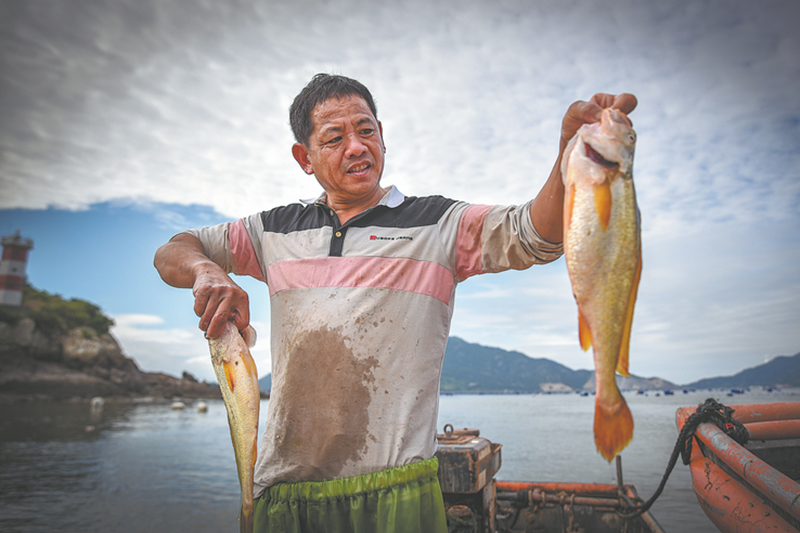
A fisherman displays his catch of large yellow croaker in Ningde. Workers process large yellow croaker at a factory in Ningde. CHINA DAILY
The race to keep it fresh
Once a fish leaves the sea cage, Chen Yubin starts thinking about time.
Chen is chairman of Fujian Hanteng Fishery, which supplies large yellow croaker to supermarkets and fresh-food chains, traditional markets and hotel groups.
The company sells across China, with East China accounting for its biggest market.
"Our customers do not all want the same thing," he says.
Some still want live fish, while others want fish that have already been cleaned and frozen and can be taken home for easy cooking.
Live large yellow croaker can be transported by specialized trucks to cities including Shenzhen and Guangzhou in Guangdong province, as well as Xiamen and Fuzhou in Fujian. But keeping fish alive during a long journey requires specialized transport, and losses can increase.
That is why about 70 percent of Hanteng's annual sales are frozen fish, Chen says.
"If we can get it to consumers within 24 hours, the freshness is still very good, while the cost is much lower," he says.
Chen says the company's sales have grown by about 30 to 50 percent a year since 2021.
Demand is relatively steady through the year, but traditional festivals can quickly change the numbers.
Sales can reach three to five times normal levels in the days before the Mid-Autumn Festival, while Spring Festival and Dragon Boat Festival also bring peaks, he says.
The company is now establishing a distribution warehouse in East China to shorten the journey further.
The fish is still most familiar in coastal parts of China, where a whole steamed or braised fish is often placed at the center of a family meal.
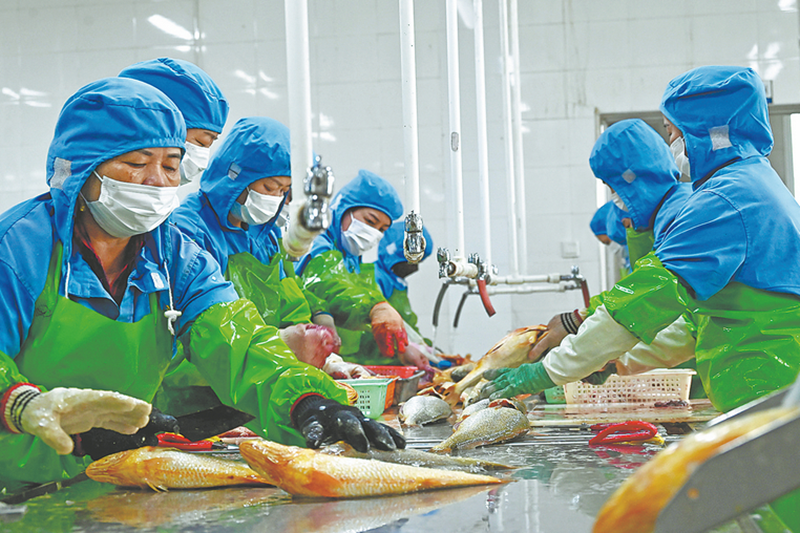
The fish is increasingly sold as frozen fillets and ready-to-eat products, expanding beyond traditional coastal dishes to reach consumers at home and abroad. CHINA DAILY
But companies selling it farther from the coast are also trying to make the fish easier to choose, not just easier to cook.
For years, the quality of farmed large yellow croaker could be difficult for consumers to judge before buying. Fish of different quality could look similar on the market, while prices varied among producers and regions.
Ningde is now trying to put more structure behind those differences.
The city has introduced a five-level grading system for high-quality farmed large yellow croaker. The system covers indicators including appearance and quality, giving producers and buyers a common reference instead of leaving the value of a fish largely to visual judgment.
You Chengyin, deputy head of the Ningde ocean and fisheries bureau, says the change is part of a broader effort to improve the quality of the fish rather than simply expand production.
Since 2018, Ningde has been upgrading its marine farming facilities, replacing older wooden rafts and foam floats with more standardized equipment and moving some production toward larger cages and deeper, more open waters. Farmers have also adopted more digital tools for feeding and managing the fish, You says.
The city has also organized culinary events under the "One Fish, One Feast" campaign in Ningde and other cities, with chefs developing dishes around large yellow croaker.
You says the city is working with companies on technologies to improve processing and preserve freshness, including automated slicing and bone detection.
The efforts are taking the fish into markets well beyond Fujian. Ningde's large yellow croaker products now reach more than 60 countries and regions, with South Korea among the important overseas markets, according to local producers.
"We are shifting from winning through volume to winning through quality," You says.

Copyright © General Office of Fujian Provincial People's Government
Website Identification Code 3500000049Registration Number: 15003084
All rights reserved. The content (including but not limited to text, photo, multimedia information, etc) published in this site belongs to fujian.gov.cn.
Without written authorization from fujian.gov.cn, such content shall not be republished or used in any form.
