


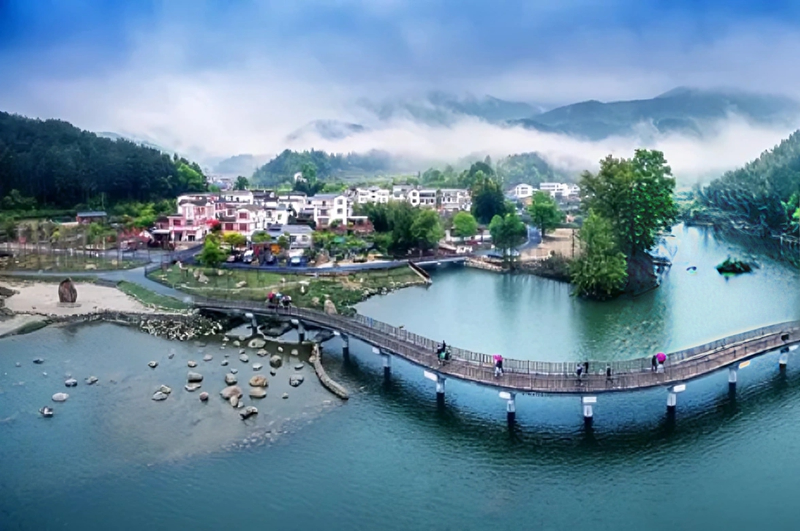
An aerial view of Yunzhai village in Longyan's Wuping county in East China's Fujian province. [Photo/chinadaily.com.cn]
Longyan is a city in southwestern Fujian province, and borders Guangdong province to the South and Jiangxi province to the West.
It boasts titles including National Civilized City, National Sustainable Development Experimental Zone, and National Pilot Area for Ecological Civilization Construction. The city has been selected as one of the Chinese cities to carry out innovative city construction.
Longyan has a humid subtropical climate with short, mild winters and long, hot, and humid summers. It is an important mining area with many forests in Fujian. By the end of 2025, the city's permanent resident population stood at 2.67 million.
In 2025, Longyan recorded a gross regional product (GRP) of 357.86 billion yuan ($52.68 billion), up 4.5 percent year-on-year. The added value of the city's primary, secondary, and tertiary industries totaled 32.32 billion yuan, 147.86 billion yuan, and 177.68 billion yuan, respectively, up 2.8 percent, 4 percent, and 5.2 percent from the previous year.
It is renowned for the architectural wonders of the Hakka tulou — or earthen building — a type of rural dwelling in Fujian that combines accommodation and fortification.
Set amongst rice, tea, and tobacco fields, the tulou features tall fortified mud walls capped by tiled roofs with wide over-hanging eaves. They are inscribed as exceptional examples of a building tradition and exemplify a particular type of communal living and defensive structure, have a harmonious relationship with the environment, and are an outstanding example of human settlement.
There are 23,000 tulou scattered about Longyan's Yongding district. The district is also home to the "prince of Hakka tulou", which was placed on the World Heritage List in 2008.
Longyan's Yongding district has planted more than 60,000 mu (about 4000 hectares) of persimmon orchards, with an annual output reaching 58,000 metric tons.
Longyan is also renowned for its local red tourism, which refers to visiting historical sites that have a modern revolutionary legacy. It is also home to the former site of the Gutian Meeting, which was a historical event for the Communist Party of China and the army.

Copyright © General Office of Fujian Provincial People's Government
Website Identification Code 3500000049Registration Number: 15003084
All rights reserved. The content (including but not limited to text, photo, multimedia information, etc) published in this site belongs to fujian.gov.cn.
Without written authorization from fujian.gov.cn, such content shall not be republished or used in any form.
