


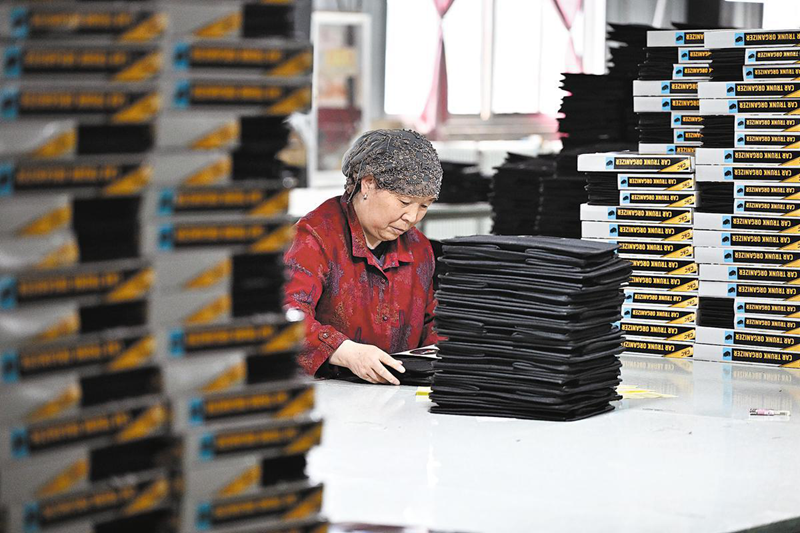
A worker processes products at a factory for suitcases and bags in Guyuan, Ningxia Hui autonomous region, in July. ZHANG BIN/CHINA NEWS SERVICE
The paired assistance initiative between East China's Fujian province and Northwest China's Ningxia Hui autonomous region — a landmark east-west poverty alleviation program launched in 1996 — has evolved into a powerful model for balanced regional development, experts said.
Reflecting on this three-decade journey, Qiu Shuilin, an associate research fellow at the Fujian Academy of Social Sciences, said that although Fujian and Ningxia are far apart, China's strategic decision 30 years ago to pair eastern advantages with western resources aimed to ensure that development leaves no one behind.
"Beyond economic aid, it underscores a national governance approach that drives regional coordination and showcases institutional strengths," Qiu said, adding that, driven by top-level design, the mechanism systematically channels funds, technology and expertise from advanced areas to developing ones.
Official data showed that, over the years, 39 economically advanced counties and districts in Fujian have paired with nine in Ningxia, facilitating exchanges involving more than 600 officials to share governance expertise.
Industrially, over 1,600 Fujian enterprises have invested over 100 billion yuan ($14.89 billion) in Ningxia, forging deep supply-chain synergies in local agriculture, such as wine, wolfberries and livestock, as well as cutting-edge artificial intelligence computing centers that power Fujian's digital needs while driving Ningxia's development.
The partnership focuses heavily on livelihoods and employment. Through labor platforms, it has facilitated 330,000 labor transfers, while using local workshops and e-commerce to support another 200,000 nearby jobs.
In 2018, Fujian battery-maker Scud Group founded a vocational education college in Ningxia's Guyuan city with a three-year training program. Students learn theory in Ningxia in year one, complete practical training in Fujian in year two, and finish with corporate internships in year three — a model that bridges classroom learning with factory production.
"We train exactly what the market demands," said Jiang Zhicheng, the group's vice-president. The college has trained over 1,600 Ningxia students, with all graduates finding jobs and average monthly salaries of 5,000 yuan.
In 2020, illness forced Yang Qinqin from a once poverty-stricken family with five children to miss her high school entrance exam. The program threw her a lifeline with free tuition and housing, bringing her more than 2,000 kilometers from inland Ningxia to coastal Fuzhou, capital of Fujian, in 2021. After excelling in training, she became a Scud Group clerk in 2023. She now earns up to 6,000 yuan a month and moved her mother to Fuzhou in 2024.
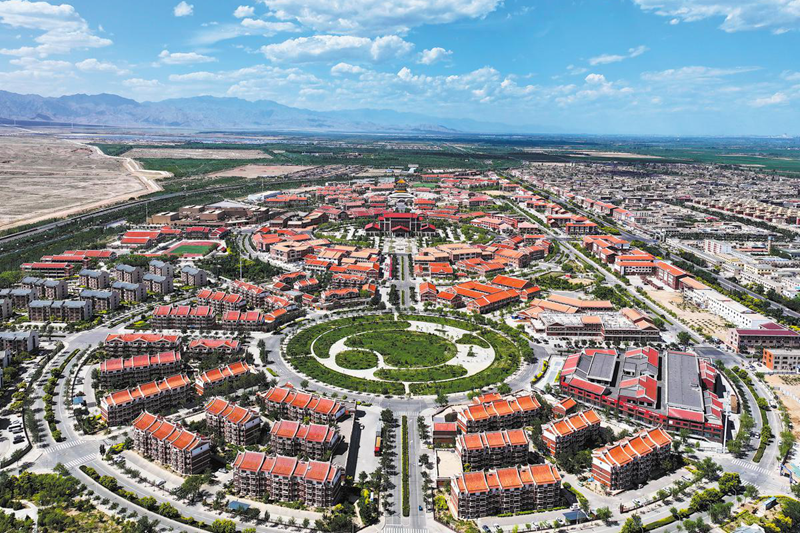
Minning town in Yinchuan is a major settlement developed through the pairing program between Fujian province and Ningxia. YUAN HONGYAN/FOR CHINA DAILY
"The contrast was striking — moving from the mountains to the sea," Yang said. "Without this opportunity, I would still be trapped in that small town, likely married and having children at a younger age. The Fujian-Ningxia cooperation completely rewrote my life."
This cooperation has also driven rural vitalization. In Yangjiadian village of Longde county in Guyuan, the partnership has sparked a shift from relying on aid to achieving self-sustained growth.
By utilizing cooperation funds, the remote mountain village turned traditional courtyards into boutique homestays. Zhao Zhiren, the village's Party chief, said that Fujian brought ideas and talent as well as capital.
To improve public services, Fujian has dispatched over 7,000 education and healthcare professionals to Ningxia. This framework has fostered 163 institutional pairings, successfully improving the operations of local schools and hospitals.
Arriving at a hospital in Xiji county in Guyuan in 2025, Fujian medical expert Zheng Pengxiang focused on the urgent challenge of utilizing advanced equipment that often sat idle once aid experts left.
"Our mission was to build a local medical team that never departs," Zheng said, addressing the high incidence of urinary stones associated with local water and diet.
Backed by 7.68 billion yuan in financial aid, Ningxia has continuously upgraded its rural infrastructure, public services and distinctive local industries.
Driven by these investments, Ningxia's per capita GDP had reached nearly 78,000 yuan by 2025, almost 19 times the 1996 level, according to official data.
Qiu said that the pairing cooperation has replaced simple fiscal transfers with a government-led and market-driven dual framework, allowing the cooperation to evolve from basic financial aid to self-sustaining industrial partnerships, and now to mutual empowerment.
"This ongoing momentum thrives on resource complementarity and mutual benefit," Qiu said, adding that such a model vividly embodies the essence of Chinese modernization aimed at common prosperity.
The practice proves that regional development imbalance — a perennial global challenge — can be effectively resolved, offering a compelling blueprint for advancing modernization, he said.
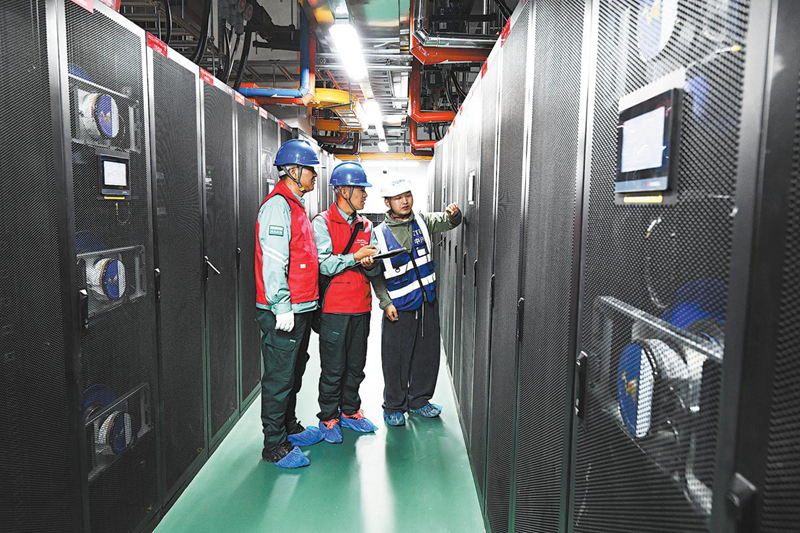
Engineers check power grid status in Minning town of Yinchuan, Ningxia, in June. A computing power center provides services in Ningxia for Fujian users. YUAN HONGYAN/FOR CHINA DAILY
Local to global
As a prime example, Juncao — a Chinese technology that uses specific grasses instead of wood to grow mushrooms and control soil erosion — served as a flagship initiative of the Fujian-Ningxia cooperation and has now spread to 118 countries, offering pragmatic insights for global poverty reduction.
In 1997, Lin Zhanxi, the inventor of Juncao, introduced Juncao technology to Xihaigu, a heavily eroded and resource-scarce region in Ningxia. Despite facing an unfamiliar, arid landscape, Lin's team drew on their years of poverty alleviation experience to help local farmers build a thriving industry from scratch.
His daughter, Lin Dongmei, vice-dean of the International College of Juncao Science at Fujian Agriculture and Forestry University, said that the technology's adaptation in Ningxia was a crucial turning point. "Building a sustainable industry in an ecologically fragile area with no initial resources provided a replicable template for arid and desertified regions worldwide," she said.
The key to this global success is its simplicity and broad applicability. To achieve this, Lin Zhanxi established a three-step approach: ensuring the technology is simple enough for people to understand at first glance, learn quickly, and succeed on their first try.
This grassroots success has since improved local livelihoods and fostered sustainable growth across the globe. Qiu, the researcher, said that the core lesson is that anti-poverty efforts must focus on capacity-building and adapting to local conditions, while organically combining ecological governance with industrial growth.
This offers the Global South valuable lessons, showing that the Chinese approach is not merely about material aid but a systematic methodology that transforms labor advantages into internal driving forces, and ecological burdens into green wealth, he said.
It exemplifies China's Global Development Initiative by helping developing nations forge a sustainable path that balances economic, ecological and social benefits through win-win technological cooperation, he added.

Copyright © General Office of Fujian Provincial People's Government
Website Identification Code 3500000049Registration Number: 15003084
All rights reserved. The content (including but not limited to text, photo, multimedia information, etc) published in this site belongs to fujian.gov.cn.
Without written authorization from fujian.gov.cn, such content shall not be republished or used in any form.
