


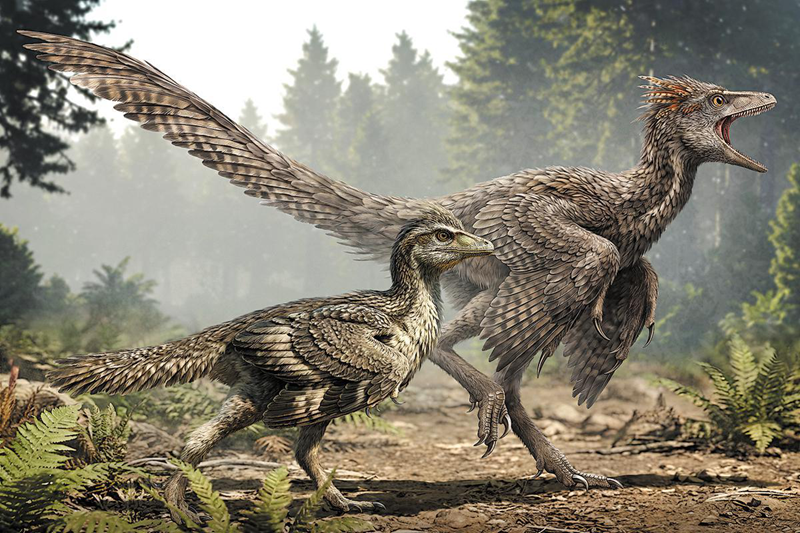
Digital reconstruction of the Jurassic bird Zhengheornis buyu from the Zhenghe Fauna. [Photo provided to chinadaily.com.cn]
Because long-tailed and short-tailed early birds appear almost simultaneously in the fossil record, with no known intermediate forms, many evolutionary biologists suggested that a transitional species with a shortened tail but no fused pygostyle — the bony structure that characterizes the tails of modern birds — was unlikely to have existed in bird evolutionary history.
They suggested that tail shortening could result from just a few genetic mutations — a hypothesis seemingly supported by the abrupt appearance of the pygostyle in the Late Jurassic.
However, the discovery of a 150-million-year-old bird fossil unearthed in Fujian province challenges that long-held assumption by providing a long-sought transitional form.
The fossil was discovered by a joint research team from the Institute of Vertebrate Paleontology and Paleoanthropology of the Chinese Academy of Sciences and the Fujian Geological Science Research Institute. The discovery followed more than 400 days of fieldwork at the Zhenghe Fauna, a Late Jurassic fossil locality in Zhenghe county, Nanping, Fujian province, renowned for yielding exquisitely preserved vertebrate fossils.
Researchers named the new species Zhengheornis buyu. The genus name refers to the discovery site, while the species name is derived from the Chinese word meaning "unexpected" in Discourses of the States, or Guoyu, an ancient Chinese book — a tribute to the specimen's surprising tail anatomy.
Dating to the Tithonian stage of the Late Jurassic, about 148 million to 150 million years ago, the well-preserved articulated skeleton has a tail composed of only 15 shortened caudal vertebrae and lacks a pygostyle. That is significantly fewer than the number found in other early bird relatives, including Archaeopteryx, which had more than 23 caudal vertebrae, and other closely related theropod dinosaurs, which typically had more than 30.
"This tail morphology provides critical evidence for the stepwise evolution of the bird tail: vertebral reduction and tail shortening preceded pygostyle fusion in early bird evolution," said Wang Min, the study's lead and corresponding author and a professor at the Institute of Vertebrate Paleontology and Paleoanthropology.
"This landmark discovery not only reconciles long-standing academic debates regarding the timing of early avian diversification but also adds a crucial piece to the puzzle of the dinosaur-bird transition," Wang said.
The researchers said the shortened but flexible tail likely offered important functional advantages. By reducing body weight, shifting the center of gravity forward, and making the tail less rigid, Zhengheornis buyu could better control its tail feathers. This would have improved its flight stability and control compared with its longer-tailed contemporaries like Archaeopteryx.

Copyright © General Office of Fujian Provincial People's Government
Website Identification Code 3500000049Registration Number: 15003084
All rights reserved. The content (including but not limited to text, photo, multimedia information, etc) published in this site belongs to fujian.gov.cn.
Without written authorization from fujian.gov.cn, such content shall not be republished or used in any form.
