


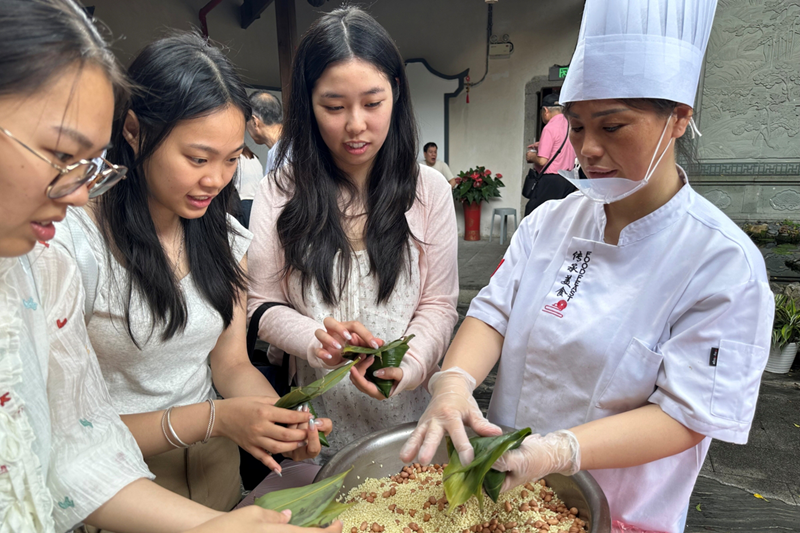
Compatriots from across the Taiwan Strait gather at the Fuzhou Taiwan Hall in Three Lanes and Seven Alleys, a historic site in downtown Fuzhou, Fujian province, on June 18 to celebrate the Dragon Boat Festival holiday. [Photo by Zhang Yi/chinadaily.com.cn]
Passenger volume on cross-Strait ferry routes is expected to reach 23,000 trips during the Dragon Boat Festival holiday, a 21 percent year-on-year increase, as more Taiwan compatriots travel to the Chinese mainland to celebrate their shared cultural heritage.
To ensure smooth travel during the holiday peak, maritime authorities have scheduled 10 additional ferry crossings. Customs terminals in Xiamen, Fujian province, have also been decorated with traditional mugwort and festive zongzi, or sticky rice dumplings, to welcome arriving Taiwan compatriots.
At Fuzhou South Railway Station, a festive event was held on June 18 that combined Dragon Boat Festival customs with genealogical culture. Through interactive exhibition boards and surname-themed stamps, the event attracted traveling Taiwan compatriots and highlighted cultural connections across the Strait.
Among the participants was a Taiwan traveler surnamed Liu, who was heading to Xiamen with four companions after completing a trip to the Mazu Temple on Meizhou Island in Putian, Fujian. He took part in the activities at the station.
"Both sides of the Strait are one family, and we also welcome mainland compatriots to visit Taiwan," Liu said.

Compatriots from across the Taiwan Strait gather at the Fuzhou Taiwan Hall in Three Lanes and Seven Alleys, a historic site in downtown Fuzhou, Fujian province, on June 18 to celebrate the Dragon Boat Festival holiday. [Photo by Zhang Yi/chinadaily.com.cn]
Meanwhile, 70 Taiwan compatriots gathered at the Fuzhou Taiwan Hall in Three Lanes and Seven Alleys, a historic area in downtown Fuzhou, for a festive celebration. The event featured hands-on folk activities, including zongzi wrapping and herbal pouch making, as well as a food-tasting area showcasing flavors from both Fuzhou and Taiwan.
"No matter the state of cross-Strait relations, grassroots exchanges continue," said Chang Tun-wei, a Taiwan entrepreneur who opened a restaurant in Fuzhou in 2019. "Food is the easiest way to lower barriers and foster mutual understanding among people."
Chang said culinary traditions and festival customs remain similar on both sides of the Strait because many people in Taiwan trace their ancestry to Zhangzhou and Quanzhou in Fujian province. This shared history means that the food cultures of the two sides stem from the same geographical roots, he added.
Yang Li-chu, an associate professor at Fuzhou University of International Studies and Trade, attended the event with three students and documented the festivities together.
"Having crossed the sea to come to Fuzhou, finding identical customs gives me a genuine feeling of being back home," Yang said.
It is regrettable that traditional Chinese culture is increasingly marginalized in Taiwan because of political factors, Yang said, adding that she hopes academic and cultural exchanges will help younger generations in Taiwan gain a better understanding of their heritage.
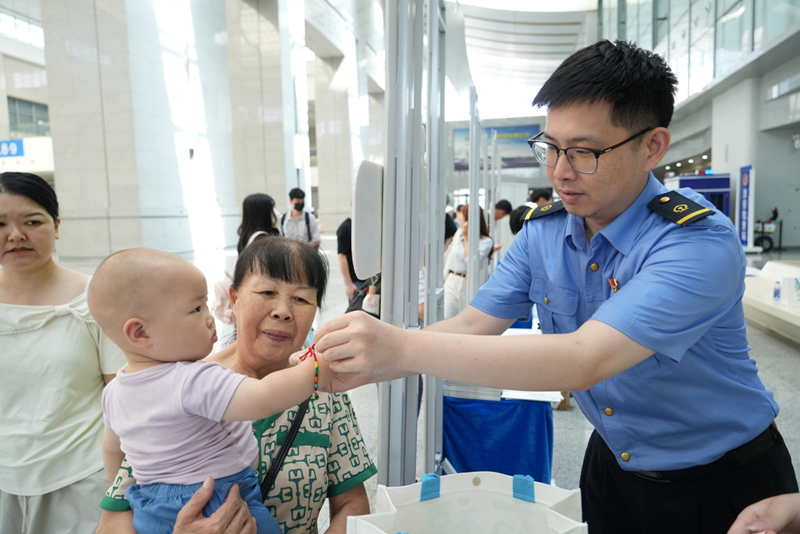
At Fuzhou South Railway Station, a festive event is held on June 18, combining holiday customs with genealogical culture. [Photo provided to chinadaily.com.cn]

Copyright © General Office of Fujian Provincial People's Government
Website Identification Code 3500000049Registration Number: 15003084
All rights reserved. The content (including but not limited to text, photo, multimedia information, etc) published in this site belongs to fujian.gov.cn.
Without written authorization from fujian.gov.cn, such content shall not be republished or used in any form.
