


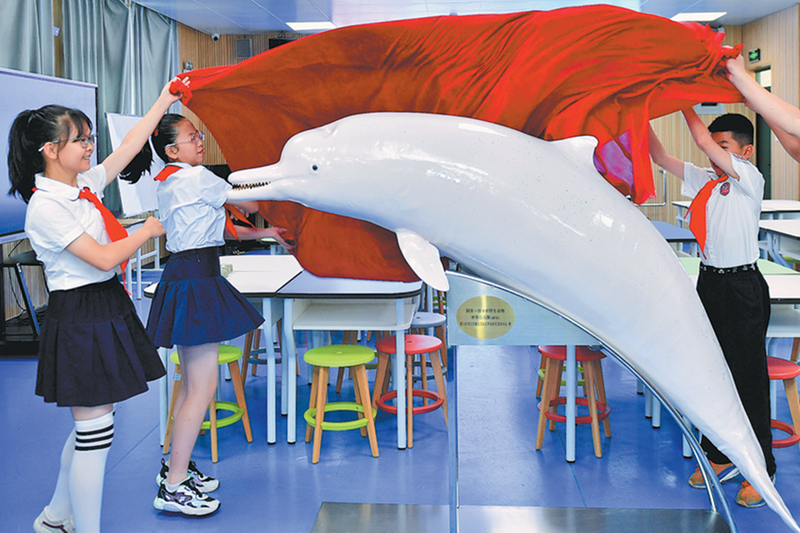
A teacher and students unveil a model of a Chinese white dolphin that was donated to Xiamen Binhai Primary School in Xiamen, Fujian province, by the Xiamen Chinese White Dolphin and Amphioxus Nature Reserve. The school is the city's first to introduce marine ecology preservation into its curriculum. CHINA DAILY
Three neighboring coastal cities in East China's Fujian province — Xiamen, Quanzhou and Zhangzhou — have recently launched a landmark cross-regional collaboration to protect the Chinese white dolphins in their shared waters.
Xiamen is China's only major city where these marine mammals, under first-class State protection and affectionately nicknamed the "giant pandas of the sea", live right alongside bustling urban life and can be spotted occasionally by residents. It is estimated that around 80 Chinese white dolphins inhabit Xiamen's waters.
"Protecting white dolphins requires pulling the entire society together," said Xu Jing, an official at the Xiamen Chinese White Dolphin and Amphioxus Nature Reserve Affairs Center. "We focus on mobilizing volunteers to join our rescue and monitoring teams."
As the dolphins frequently migrate out of Xiamen's waters into neighboring areas, local enforcement teams officially upgraded this cross-regional mechanism last month to formally institutionalize real-time data sharing, joint maritime patrols and emergency rescues, according to Xu.
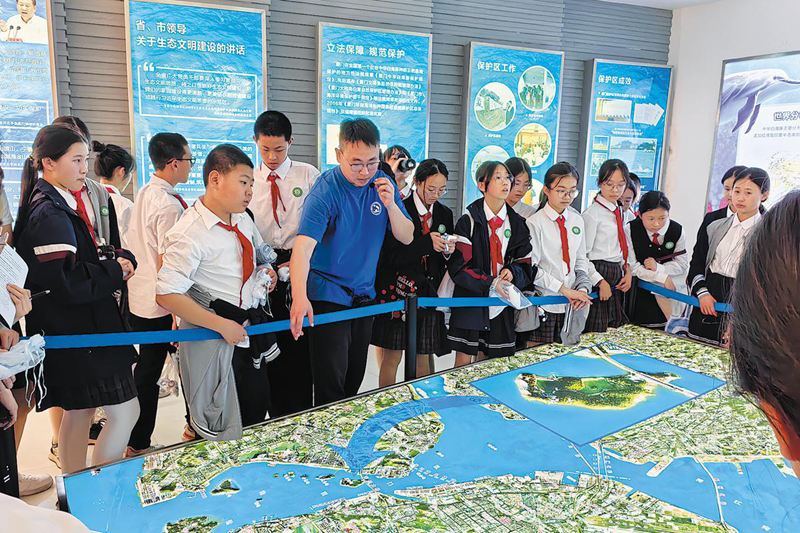
A docent introduces the Chinese white dolphin preservation work in Xiamen at a museum in the city. CHINA DAILY
The upgraded mechanism also aims to further raise public awareness, including educating citizens on what to do and how to call for help if they encounter a stranded dolphin.
In August 2024, people from both Xiamen and Quanzhou jointly handled the emergency rescue of Le Bao, a 4-year-old female dolphin that swam out of Xiamen and became stranded on a beach in Quanzhou's waters.
Local residents reported the stranding, triggering a rapid emergency chain that brought experts from the dolphin reserve in Xiamen and the Third Institute of Oceanography, Ministry of Natural Resources, based in Xiamen, to the scene for a joint medical response.
Following more than 40 days of intensive care at a nearby aquatic rescue station, Le Bao fully recovered and was successfully released back into her home environment in Xiamen's waters in September 2024. She was later named Le Bao after the facility, a name that also carried the rescuers' wishes for her to live a joyful life in the future.
"Le Bao's survival was a miracle made possible by an unbroken chain of rapid actions across two cities," Xu said. "If any single link had failed, this successful release would not have been possible."
The dolphin population's stable presence also stems from Xiamen's long-term ecological initiatives, including a complete clearance of marine aquaculture facilities to restore the coastal ecosystem to its natural state, she said.
The city even re-engineered a tunnel project from an original above-water bridge design into an underground tunnel, heavily increasing capital investments solely to preserve the dolphins' habitats, she added.
"As a flagship barometer of our marine ecosystem, their presence represents Xiamen's outstanding achievements in biodiversity conservation," Xu said.
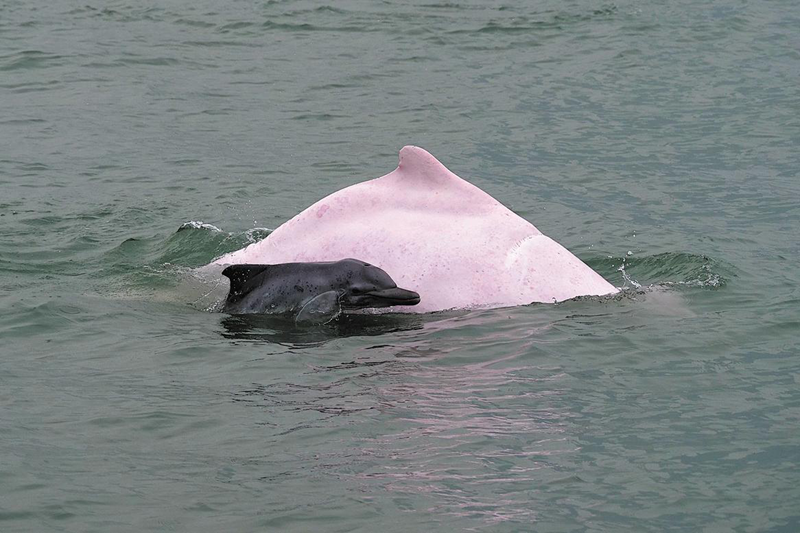
Star Chinese white dolphin Da Bai is seen swimming with her calf in Xiamen in 2020. CHINA DAILY
Local paddleboarders, open-water swimmers and wildlife photographers in Xiamen have voluntarily established a grassroots monitoring network, capturing footage during unplanned encounters to support scientific research.
Chen Yu, a local open-water swimmer and photographer who has been tracking the species via aerial drone in recent years, said that public engagement is deeply rooted in local tradition. The dolphins are traditionally called "Mazu fish" after the sea goddess, and are regarded by residents as guardians of the waters.
"Since childhood, we have been told by our elders that the waters are safe wherever the white dolphins appear," Chen said. "For local residents, these animals are seen as traditional protectors of the sea."
These photographic sightings provide critical data for marine biologists. Images documenting maternal behaviors, such as a mother lifting her calf to breathe or teaching it to hunt, assist researchers in managing a digital profiling system that tracks family dynamics and newborn calves.
In April, an aerial drone photographer captured footage of a newborn calf swimming closely alongside Da Bai, a well-documented wild female dolphin frequently seen nursing newborns in Xiamen's waters.
"When we photograph a dolphin year after year and see it is still there, we know it is growing up healthy and strong," Chen said. "Every encounter still makes me feel incredibly lucky."
Marine experts have introduced a science-based maritime code of conduct, instructing water sports enthusiasts and photographers to maintain a respectful distance instead of chasing the animals.
Lin Yuan, a local middle school teacher who is a paddleboarder, regularly records her encounters with the animals in the sea to use as educational materials in her classroom.
"I bring my own dolphin encounter videos to share with my students," Lin said. "We must cultivate an awareness of biodiversity conservation in children so they can continue to see these marine creatures in their local environment in the future."

Copyright © General Office of Fujian Provincial People's Government
Website Identification Code 3500000049Registration Number: 15003084
All rights reserved. The content (including but not limited to text, photo, multimedia information, etc) published in this site belongs to fujian.gov.cn.
Without written authorization from fujian.gov.cn, such content shall not be republished or used in any form.
