


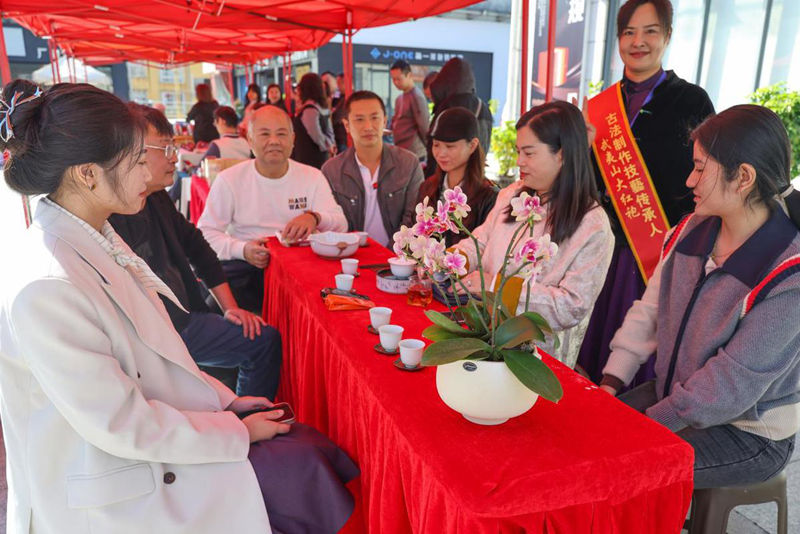
Participants explore Wuyi tea art through a tasting session. [Photo provided to chinadaily.com.cn]
The eighth Great Tea Road and Belt and Road Initiative Cultural and Trade Exchange and the award ceremony for the second Lu Yu Tea King Competition were held on Nov 17 in Wuyi Mountain, Nanping, Fujian province.
Recognized as a UNESCO World Heritage Convention site, Wuyi Mountain is the birthplace of black tea and oolong tea, the origin of the Great Tea Road, and a region renowned for its rich tea germplasm resources.
This year's competition saw the participation of more than a thousand tea enterprises. After rigorous evaluations by a panel of tea experts, "Tea King" titles were awarded across 18 categories such as Da Hong Pao (Wuyi rock tea).
The winning enterprises will be listed as key promotion candidates in 2026 by the China Council for the Promotion of International Trade Fujian Sub-Council.
The Great Tea Road, which emerged in the late Ming and early Qing dynasties (1368-1911), once stretched for more than 10,000 kilometers. It carried the aroma of Wuyi tea from south to north, across China's Central Plains and the Gobi Desert, through Kyakhta on the Russian border, across Siberia, and into Europe.
As an integral part of the Belt and Road Initiative, the Great Tea Road serves as a bridge connecting past and present and strengthening cultural and economic ties.

Copyright © General Office of Fujian Provincial People's Government
Website Identification Code 3500000049Registration Number: 15003084
All rights reserved. The content (including but not limited to text, photo, multimedia information, etc) published in this site belongs to fujian.gov.cn.
Without written authorization from fujian.gov.cn, such content shall not be republished or used in any form.
