


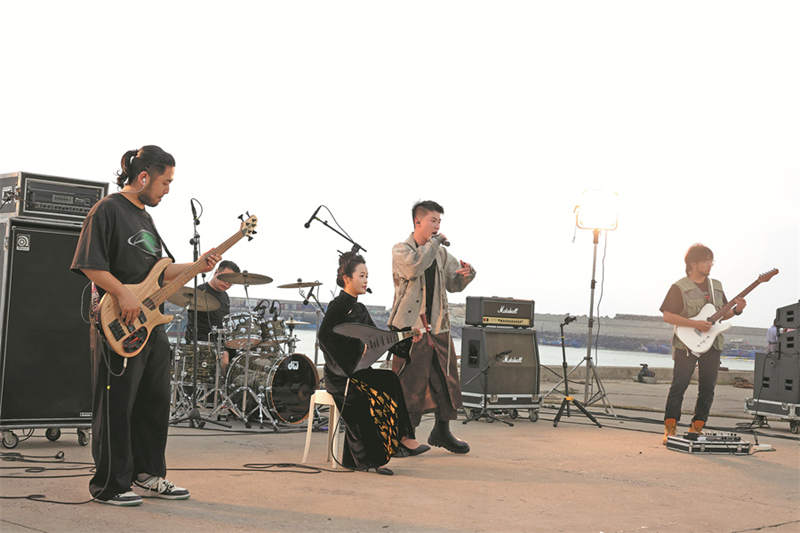
By giving the traditional art a contemporary twist, Nanyin New Force approaches Nanyin with sincerity and a strong sense of responsibility. [Photo provided to China Daily]
For more than 1,000 years, the music of Nanyin — one of the oldest existing musical genres in China — has carried the sounds of southern China through generations.
Now, a group of young musicians in Quanzhou, Fujian province, is giving the ancient tradition a contemporary voice by pairing its distinctive melodies and vocal style with folk, pop, blues, electronic music and modern instrumentation.
Called Nanyin Xin Shili, or Nanyin New Force, the ensemble is less a fixed band than a creative collective. Its members come from different musical and artistic backgrounds, using Nanyin as a starting point rather than a boundary.
At its center is Chen Huanxi, a Nanyin inheritor who has been immersed in the tradition since childhood. Yet her relationship with Nanyin was far from straightforward.
As a child, Chen was energetic and easily bored. She began learning pipa (four-stringed Chinese lute) largely because her friends were doing it. The slow pace of Nanyin initially frustrated her, and she once argued with her parents because she wanted to study painting instead.
Known for its restrained melodies, distinctive singing style and traditional instruments such as the pipa, dongxiao (Chinese vertical bamboo flute), sanxian (three-stringed lute) and erxian (a two-stringed instrument), Nanyin is often described as a "living fossil" of Chinese music and was inscribed on UNESCO's Representative List of the Intangible Cultural Heritage of Humanity in 2009.
"I always thought I didn't like Nanyin," says Chen, born in 1995. "It was only much later that I suddenly realized I had never been able to separate myself from it."
That realization came after years of working with the tradition in increasingly unconventional ways.
Chen graduated from Quanzhou Normal University in 2017, where she studied Nanyin. She went on to teach the music, perform in local teahouses and eventually became a freelance musician, taking Nanyin to the streets, bars and cafes.
She began explaining the centuries-old art form to curious passersby and asking audiences what they wanted to hear.
"What surprised me was that some people in Quanzhou didn't even know what I was singing," she says. "I thought, this isn't right. This is such beautiful music. People should be able to understand it."
For Chen, the challenge was not simply preserving Nanyin, but closing the distance that had grown between the tradition and the people whose lives it once accompanied.
Nanyin New Force is interested in what happens when that centuries-old sound meets the musical vocabulary of today, as Chen puts it.
Their approach is not to overwrite Nanyin with electronic beats or pop arrangements, but to preserve what makes the tradition recognizable while allowing it to enter new musical contexts.
The group may retain traditional Nanyin instruments while adding guitar, bass, and drums. It may incorporate Nanyin singing into an original folk song, or create new music specifically shaped around the vocal style of the tradition.
One example is Yue Niang Yue Guang Guang (Moon, Moonlight), a Minnan (the southern area of Fujian province) children's song familiar to generations of local people. The group retains the original lyrics but reimagines the song through Nanyin-style singing and contemporary instrumentation.
The song will be performed in Beijing on Sept 24, a day ahead of Mid-Autumn Festival. Along with China Broadcasting Film Symphony Orchestra, the ensemble, featuring six musicians headed by Chen, will give the song new life, bringing the sounds of southern Fujian into a new orchestral setting.
"It is a memory shared by Minnan people," Chen says. "We wanted to return to something plain and simple, something that can make people happy."
Among the younger musicians helping to shape that sound is Wu Xuanhui, a Quanzhou native born in 1999. A music producer and songwriter now based in Shanghai, Wu grew up immersed in the contemporary musical world of pop music and short videos. He began forming his own music groups in high school and later shifted from pop performance to music production.
His connection with Nanyin, however, began much earlier.
Wu remembers his grandfather, who played pipa and erhu (two-stringed Chinese fiddle) and listened to Nanyin on a radio in their village. As a child, Wu was exposed to the music but did not yet understand it.
"I couldn't understand it when I was young, and I would fall asleep listening to it," he says.
Only later did he begin to hear something different.
"Nanyin is a conversation across 1,000 years," Wu says. "When the music starts, you can almost feel the era it comes from. It takes you into the world of Quanzhou."
Wu first met Chen while working on music projects that sought to incorporate local cultural elements. Their collaboration gradually developed into a creative partnership, with Wu handling songwriting, arrangement and production, while Chen brought her deep knowledge of Nanyin singing and musical conventions.
The division of labor is not simply traditional versus modern. It is a process of learning from each other.
Wu may begin with lyrics and a melodic idea. Chen then reshapes the material according to the rhythms and expressive principles of Nanyin by adjusting long notes, diction and phrasing.
For Wu, the goal of such crossovers is not necessarily for audiences to walk away knowing the technical vocabulary of Nanyin.
"What matters is that the music leaves an impression and makes people curious about the culture," he says.
That culture can enter through music, but also through the details of everyday life — Quanzhou food, local opera, streets, and landmarks.
"Nanyin shaped me," Chen says. "Now I want people to know that Nanyin can be beautiful, enjoyable and fun."

Copyright © General Office of Fujian Provincial People's Government
Website Identification Code 3500000049Registration Number: 15003084
All rights reserved. The content (including but not limited to text, photo, multimedia information, etc) published in this site belongs to fujian.gov.cn.
Without written authorization from fujian.gov.cn, such content shall not be republished or used in any form.
