


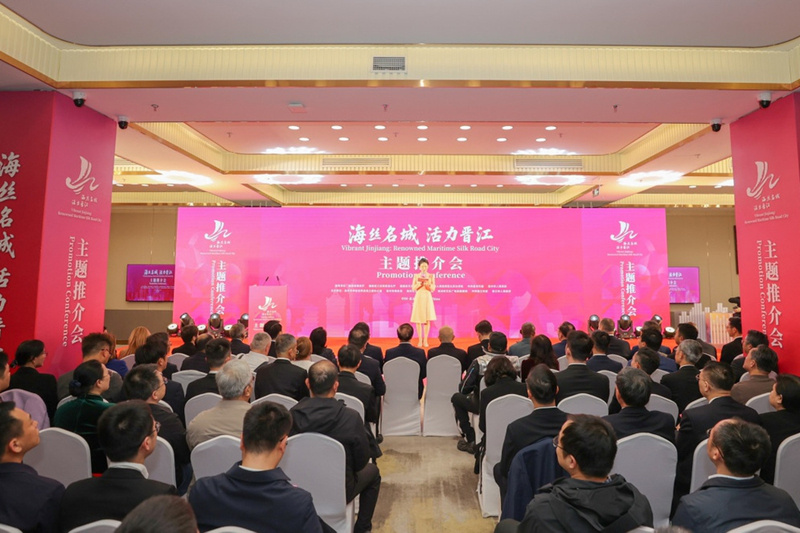
A promotion event, named Vibrant Jinjiang: Renowned Maritime Silk Road City Promotion Conference, is held on March 15 in Beijing. CHINA DAILY
To understand how China plans to unlock domestic demand in the years ahead, look no further than a single city's playbook unfolding in Beijing.
Launched on March 15 and running for one month, the "Super Jinjiang, Happy Shopping in Beijing" consumption promotion campaign brings together 12 of China's prominent consumer brands, including sportswear brands Anta, Xtep, and Kelme, menswear brand Lilanz, and fitness equipment supplier SHUA Fitness.
More than 200 stores across the capital are rolling out synchronized discounts, covering a full spectrum of consumer goods from professional sportswear, high-end business apparel, and fitness equipment to daily casual wear.
These brands are far more than just household names across China — they have also earned their place on the global stage.
At the recently concluded Milan-Cortina 2026 Winter Olympics, the eye-catching blue-and-white custom outerwear worn by gold medalist Gu Ailing of China was made by Anta.
What is even more striking is that every one of these well-known brands hails from Jinjiang, a coastal county-level city in East China's Fujian province.
This small city, easy to overlook on a map, has nurtured a cluster of leading consumer brands and stands as a vivid example of China's grassroots efforts to boost domestic consumption.
This local initiative aligns with national priorities. The 2026 Government Work Report, for example, identifies expanding domestic demand as its chief task.
Internationally, momentous changes of a magnitude not seen in a century are unfolding across the world at a faster pace.
"We should respond to external uncertainty with the certainty of our own domestic economic and social development," Yao Jingyuan, special researcher at the Counsellors' Office of the State Council, said at a recent forum.
"Strengthening the domestic market and growing household consumption is the most critical structural reform for China's next level of growth," Asif S. Cheema, Asian Development Bank's country director for China, said when asked about the organization's views on China's plan to realize a notable increase in household consumption as a share of GDP over the next five years during a recent interview with China Daily.
At the national level, the Ministry of Commerce has rolled out a dual-drive framework combining policy support and promotional campaigns to boost consumption.
"The promotion event held in Beijing closely aligns with the strategic goal of building a strong domestic market and pursuing domestic demand-led growth," Wang Mingyuan, secretary of the CPC Jinjiang Municipal Committee, said at the city's promotion conference in which the campaign was launched.
"The campaign is Jinjiang's step to cultivate new consumption momentum," Lin Qi, director of Jinjiang Commerce Bureau, said. "For brands from Jinjiang, it signals a decisive upgrade from selling products to building brands."
Jinjiang is using its "Super Jinjiang" shopping IP as a key platform, fully unlocking consumption potential and guiding local enterprises to explore new growth areas such as the IP economy, fashion economy, and debut economy, according to Lin.
"Enterprises are also encouraged to expand supply of new products tailored to interest-driven, green, and health-focused consumption, so as to meet the public's evolving demand for diversified, personalized, and high-quality goods," Lin said.
In this year's Government Work Report, building a robust domestic market was listed at the top among the major tasks. Special initiatives to boost consumption, according to the report, will continue to be advanced.
250 billion yuan ($36.36 billion) in ultra-long special treasury bonds will be earmarked for consumer goods trade-in programs, according to the report.
Beyond a short-term stimulus, China's strategy also focuses on industrial upgrading to stabilize employment and raise incomes over the medium term, and on strengthening social security, income support, and public services to shore up consumer confidence in the long run.
The scale and ambition of the campaign are backed by Jinjiang's industrial heritage and vibrant private sector, the core of the widely recognized "Jinjiang Experience".
The "Jinjiang Experience" refers to the transformation of Jinjiang, which used to be a poor county with a large population and little land in Fujian province, into an economic powerhouse with a well-developed economy.
It focuses on the real economy, draws momentum from reform and innovation, and stresses effective government-enterprise cooperation.
Pursuing innovative development of the "Jinjiang Experience" has been included in China's 15th Five-Year Plan.
This forward-looking strategy has enabled Jinjiang to become one of China's top county-level economies and a representative model of Chinese-style modernization at the local level.
"In 2025, Jinjiang's GDP reached 386.18 billion yuan, and its economic aggregate remained among the top three counties nationwide," Wang said.
The private sector contributes over 90 percent of Jinjiang's GDP, tax revenue, R&D investment, and number of enterprises, according to Wang.
A thriving private sector lays the foundation for abundant brands, diverse products, and a resilient supply system.
Jinjiang has built a cluster of industrial pillars — textile, footwear, and apparel valued at over 400 billion yuan.
The 2026 Government Work Report calls to further boost domestic demand and improve supply. Such a strong and diversified supply helps meet consumer demands more effectively and boosts people's willingness to spend.
"We highly value Fujian's rich experience in private-sector development and its dynamic approach to cultural and economic exchange," Fazeel Najeeb, the Maldives' ambassador to China, said during the conference.
Beyond its industrial achievements, Jinjiang's well-developed public services and inclusive urban development have underpinned its consumption growth momentum.
This focus on livelihood security to unlock consumption potential aligns with the long-term structural reform direction highlighted by Cheema.
"In the long term, structural reforms are needed," he said, underscoring the importance of a stronger social protection program.
"Providing higher or stronger pension systems and reducing the cost of healthcare would provide more comfort to households, and enhance their ability to spend," he added.
The city has a permanent population of around 2.5 million, more than half being non-local residents, and offers high-quality education and healthcare services, according to Wang.
Its holistic livelihood improvements have shored up residents' consumer confidence — a core pillar for sustained growth in household spending.
Jinjiang's vibrant private sector also contributes more than 90 percent of the city's urban employment, and has fostered a pervasive entrepreneurial spirit across the city.
Today in Jinjiang, one in every seven residents is a business owner, according to Wang.
From brand collaborations to policy arrangements, China is tapping into the enormous potential of its domestic market, using the stability of its own development to navigate the uncertainties of the external environment.
This consumption initiative not only showcases the strength of Chinese brands but also points to a clear path for expanding domestic demand.

Copyright © General Office of Fujian Provincial People's Government
Website Identification Code 3500000049Registration Number: 15003084
All rights reserved. The content (including but not limited to text, photo, multimedia information, etc) published in this site belongs to fujian.gov.cn.
Without written authorization from fujian.gov.cn, such content shall not be republished or used in any form.
